
How to Support a Loved One With Addiction Without Losing Yourself
Loving someone who struggles with addiction can leave you feeling worried, exhausted, angry, and helpless. Learn how to offer support while protecting your own emotional well-being.
When someone you love is struggling with addiction, you may feel like you're living in a constant state of uncertainty.
You worry about them.
You worry about what they'll do next.
You wonder whether they're telling you the truth.
You may find yourself checking in, covering for them, fixing problems, giving second chances, and trying to figure out what you can say or do to make things better.
And eventually, something happens that can be difficult to admit:
You are exhausted.
Supporting someone with addiction can affect your emotional health, your relationships, your finances, your work, and your sense of stability.
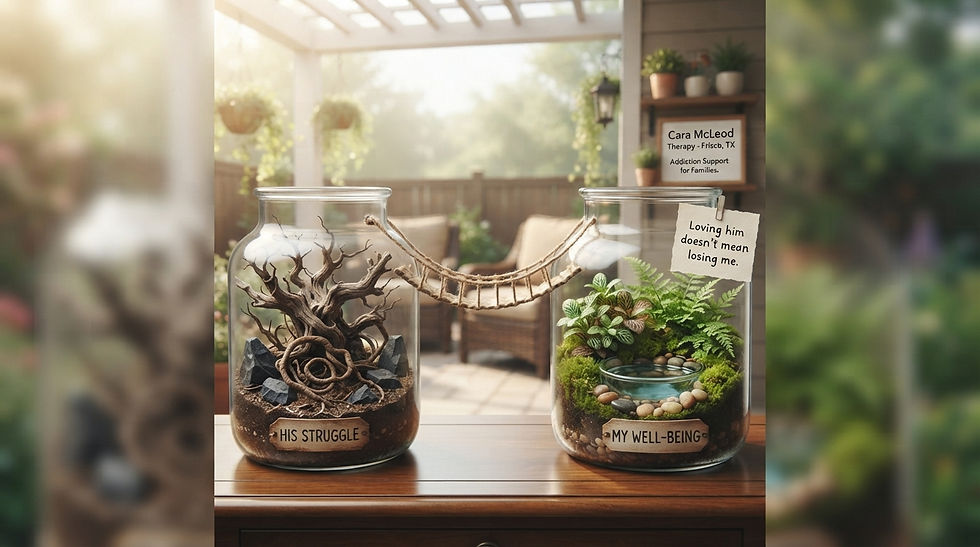
You can love someone deeply and still need boundaries.
You can care about what happens to them without taking responsibility for their choices.
And perhaps most importantly, you can support a loved one with addiction without losing yourself in the process.
You Can't Make Someone Stop Using
One of the hardest things for families to accept is that love alone cannot make someone change.
You can encourage treatment.
You can listen.
You can express concern.
You can provide appropriate support.
But you cannot control another person's decisions.
Trying to control their behavior can quickly become an exhausting cycle.
You monitor.
They hide.
You confront.
They deny.
You make rules.
They break them.
You become more anxious and frustrated, and they become more defensive.
Recognizing what you can and cannot control isn't giving up on your loved one.
It's recognizing the limits of your responsibility.
Learn About Addiction
Understanding addiction can help replace some of the confusion and judgment with a more informed perspective.
Addiction is complex and can involve biological, psychological, emotional, social, and environmental factors.
Learning about addiction may help you understand why someone can continue a behavior even when it is clearly causing problems.
It doesn't mean excusing harmful behavior.
It means understanding that "Why don't they just stop?" is often much more complicated than it sounds.
Education can also help you recognize the difference between supporting someone and unintentionally enabling them.
Set Clear Boundaries When You Support a Loved One With Addiction
Boundaries are one of the most important ways you can protect yourself while maintaining a relationship with someone struggling with addiction.
A boundary isn't a threat.
It isn't a punishment.
And it isn't a way to force someone to change.
A boundary communicates what you will and will not participate in.
For example:
"I won't give you money if I believe it's going toward substances."
"I won't lie to your employer or family to cover for you."
"I won't allow you to come into the house when you're intoxicated."
"If you become verbally abusive, I will end the conversation."
The important part is following through consistently.
A boundary only works when it describes your actions, rather than attempting to control theirs.
Stop Trying to Fix Everything
When someone you love is struggling, your instinct may be to fix things.
You call their employer.
You pay their bills.
You make excuses.
You clean up the consequences.
You schedule appointments.
You search for treatment programs.
You stay awake waiting for them to come home.
Some of these actions may feel loving in the moment.
But constantly rescuing someone from the consequences of their behavior can sometimes make it more difficult for them to recognize the need for change.
This doesn't mean you should abandon someone who needs help.
It means learning to distinguish between supporting recovery and protecting someone from every consequence of their choices.
That distinction can be difficult.
And you don't have to figure it out alone.
Don't Make Their Addiction Your Entire Life
When someone you love has an addiction, it can become easy to organize your entire life around them.
You stop making plans because you don't know what might happen.
You constantly check your phone.
You monitor their mood.
You worry about where they are.
You spend hours researching addiction.
You stop seeing friends.
You put your own needs last.
Over time, your loved one's addiction can become the center of your world.
But you still have a life.
You are still allowed to see your friends.
Go to dinner.
Exercise.
Take a vacation.
Laugh.
Sleep.
Have hobbies.
Enjoy your family.
Taking care of yourself isn't selfish.
It gives you the emotional capacity to make healthier decisions about how you want to show up in the relationship.
Watch for Resentment
Loving someone with an addiction can create complicated emotions.
You may feel compassion one day and anger the next.
You may feel guilty for being angry.
You may feel resentful because you're carrying responsibilities they aren't.
You may even feel relief when they're doing well—and immediately become anxious that something will go wrong again.
These emotions don't make you a bad person.
They're signals that you're carrying something difficult.
Instead of judging yourself for feeling angry, frustrated, or exhausted, consider what those emotions are trying to tell you.
Are you doing too much?
Have your boundaries been crossed?
Are you neglecting your own needs?
Are you taking responsibility for something that isn't yours to carry?
Those questions can be uncomfortable.
They can also be important.
Don't Confuse Boundaries With Abandonment
Many people feel guilty about setting boundaries because they worry it means they're abandoning their loved one.
It doesn't.
You can say:
"I love you, and I won't participate in this."
You can say:
"I want to support your recovery, but I can't continue covering for you."
You can say:
"I'm here to talk when you're ready to get help, but I won't have this conversation while you're intoxicated."
Love and boundaries can exist at the same time.
In fact, healthy boundaries can make relationships more honest because they remove some of the confusion around what you will and won't accept.
Take Care of Your Own Mental Health
Your loved one's addiction affects you, too.
You may experience anxiety, chronic stress, sleep problems, depression, anger, guilt, or emotional exhaustion.
You may feel like you're constantly waiting for the next crisis.
That is a lot to carry.
Talking with a therapist can give you somewhere to process those emotions without having to protect someone else's feelings.
Therapy can also help you:
Establish healthier boundaries
Recognize patterns of enabling or over-responsibility
Manage anxiety and stress
Process anger, grief, or resentment
Improve communication
Reconnect with your own needs
Decide what you can realistically control
You don't have to wait for your loved one to enter treatment before getting support yourself.
Encourage Treatment Without Becoming Their Therapist
It's natural to want to understand your loved one's addiction and help them through every step.
But you aren't their therapist.
You aren't their treatment provider.
And you aren't responsible for managing their recovery.
You can encourage them to seek professional help.
You can offer to help them research options.
You can listen when they want to talk.
But their recovery ultimately has to involve their participation and choices.
Your role is to be a loved one—not to become their entire support system.
Prepare for the Possibility of Setbacks
Recovery isn't necessarily a straight line.
There may be progress.
There may be difficult periods.
There may be setbacks.
If your loved one relapses or returns to an unhealthy behavior, you may immediately feel panic or assume that everything has failed.
Try to remember that one setback doesn't necessarily erase every step forward.
At the same time, you don't have to abandon your boundaries because someone is struggling again.
You can care about their recovery while still protecting yourself.
Remember That You Matter, Too
This may be the hardest lesson of all.
When you're worried about someone else's addiction, your own needs can feel unimportant.
You may think:
"They need me more than I need help."
"I'll deal with myself once they're okay."
"I can't focus on myself when they're struggling."
But there will always be another problem to solve.
Another phone call.
Another crisis.
Another difficult conversation.
If you keep putting yourself last, you may eventually have nothing left to give.
Your well-being matters even when someone you love is struggling.
What Does Healthy Support Actually Look Like?
Healthy support doesn't mean doing everything for someone.
It can look like:
Listening without taking responsibility for their choices.
Encouraging professional treatment.
Being honest about how their behavior affects you.
Setting boundaries and following through.
Refusing to participate in harmful behavior.
Allowing appropriate consequences to happen.
Taking care of your own physical and emotional health.
And sometimes, healthy support means recognizing that you need more distance from a situation that has become unsafe or destructive.
There is no single right answer for every family.
Your safety and well-being matter.
You Don't Have to Navigate Addiction Alone
When someone you love has an addiction, you may spend so much energy worrying about them that you forget you're affected, too.
You don't have to wait until you're completely overwhelmed before asking for support.
Therapy can give you a place to talk openly about the anger, fear, guilt, grief, resentment, and exhaustion that can come with loving someone who struggles with addiction.
You can learn how to communicate differently.
You can explore boundaries that feel healthy and realistic.
And you can begin separating what belongs to you from what belongs to your loved one.
Addiction Support for Families in Frisco, TX
At Cara McLeod Therapy in Frisco, TX, therapy can help individuals navigate the emotional impact of addiction, as well as related concerns such as anxiety, trauma, depression, stress, and relationship difficulties.
If someone else's addiction has begun affecting your emotional health or your ability to enjoy your own life, you deserve support, too.
You don't have to stop loving your family member.
You don't have to stop caring.
You simply have to remember that their recovery is theirs—and your life is yours.
Supporting someone doesn't mean sacrificing yourself.


Comments